

Research Group Makes Progress in Non-Hermitian Control of Dissipative Quantum Gases, Published in Physical Review Letters
Recently, the experimental research team led by Professors Suotang Jia, Liantuan Xiao, and Yan-Tao Zhao from the Institute of Laser Spectroscopy, together with theoretical collaborator Professor Ying Hu, published a research paper titled "Exceptional Nexus in Bose–Einstein Condensates with Collective Dissipation" in the top-tier international physics journal Physical Review Letters.
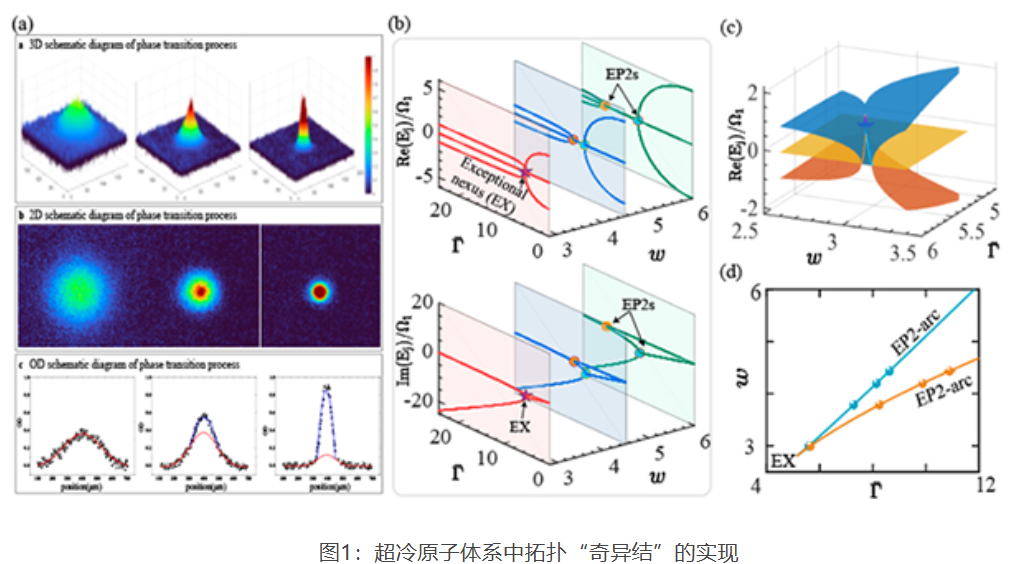
The team proposed and experimentally realized an asymmetric exceptional nexus for the first time using ultracold atoms. Non-Hermitian physics, widely present in open dissipative systems, breaks through the traditional framework of closed systems and exhibits unprecedented physical properties and application potential. A particularly notable phenomenon in higher-order non-Hermitian systems is the exceptional nexus, formed by the intersection of multiple exceptional arcs, which possesses unique hybrid topological charges and anisotropic fractional response behavior. By utilizing a dissipative Bose quantum gas, the research team constructed a higher-order non-Hermitian Hamiltonian and, through sophisticated dissipation control, observed for the first time the convergence of exceptional arcs with distinct geometric configurations and the resulting asymmetric exceptional nexus in an ultracold atomic system. This discovery opens new avenues for exploring novel non-Hermitian physics in dissipative quantum gases and advances the development of non-Hermitian quantum control.
Doctoral students Wang Chenhao and Li Nan from the Institute of Laser Spectroscopy are co-first authors of the paper, with Professors Yan-Tao Zhao and Ying Hu serving as corresponding authors. Professor Huazhong Ji and Professor Bo Yan from Zhejiang University also contributed to this research. The work was supported by the National Key R&D Program of China, the Key Program of the National Natural Science Foundation of China, and the General Program of the National Natural Science Foundation of China.
Link to the paper: https://journals.aps.org/prl/abstract/10.1103/PhysRevLett.132.253401