

Research Group Makes Advance in Non-Hermitian Quantum Effects, Published in Physical Review X
Recently, a team led by Professor Hu Ying from the laboratory, in collaboration with Professor Shi Tao from the Institute of Theoretical Physics, Chinese Academy of Sciences, has made a breakthrough in exploring non-Hermitian quantum effects. The related research findings, titled "Fractional Quantum Zeno Effect Emerging from Non-Hermitian Physics," were published in Physical Review X on July 24, 2023. The paper lists Shanxi University as the first affiliation, with Yue Sun, a Ph.D. candidate at the Institute of Laser Spectroscopy, as the first author. Professors Shi Tao and Hu Ying are the corresponding authors. Professors Suotang Jia, Liantuan Xiao, Dr. Zhiyong Liu from the Institute of Metal Research, Chinese Academy of Sciences, and Professor Zhidong Zhang also contributed to this research.
An isolated quantum system is an idealized scenario. Real quantum systems interact with their environment (i.e., a "reservoir"), leading to dissipation, which typically disrupts quantum coherence. However, by engineering the reservoir and its coupling to the system, it is possible to manipulate the system’s evolution and properties, giving rise to exotic phenomena not observed in isolated quantum systems. The research team demonstrated how to induce novel quantum effects without classical counterparts by tailoring non-Hermitian (dissipative) interactions. They also developed a theoretical framework to systematically investigate such problems.
The team studied the behavior of atoms (or artificial atoms) embedded in a novel type of reservoir. This reservoir interacts with its own environment, resulting in dissipation. The researchers discovered that by controlling such an open reservoir, unprecedented influences on the atoms can be achieved. For instance, when the reservoir undergoes strong dissipation, the spontaneous radiation of the atoms is suppressed in a peculiar manner, giving rise to a fractional quantum Zeno effect—a phenomenon unattainable with conventional reservoirs. Furthermore, the team observed dissipation-induced photon antibunching as a consequence of the fractional quantum Zeno effect. Photons naturally tend to bunch together, while photon antibunching refers to the counterintuitive phenomenon where photons avoid clustering, a unique quantum effect. Photon antibunching typically requires strong nonlinearities to occur. However, the team found that, under dissipation dominance, it can be induced even in the presence of weak nonlinearities.
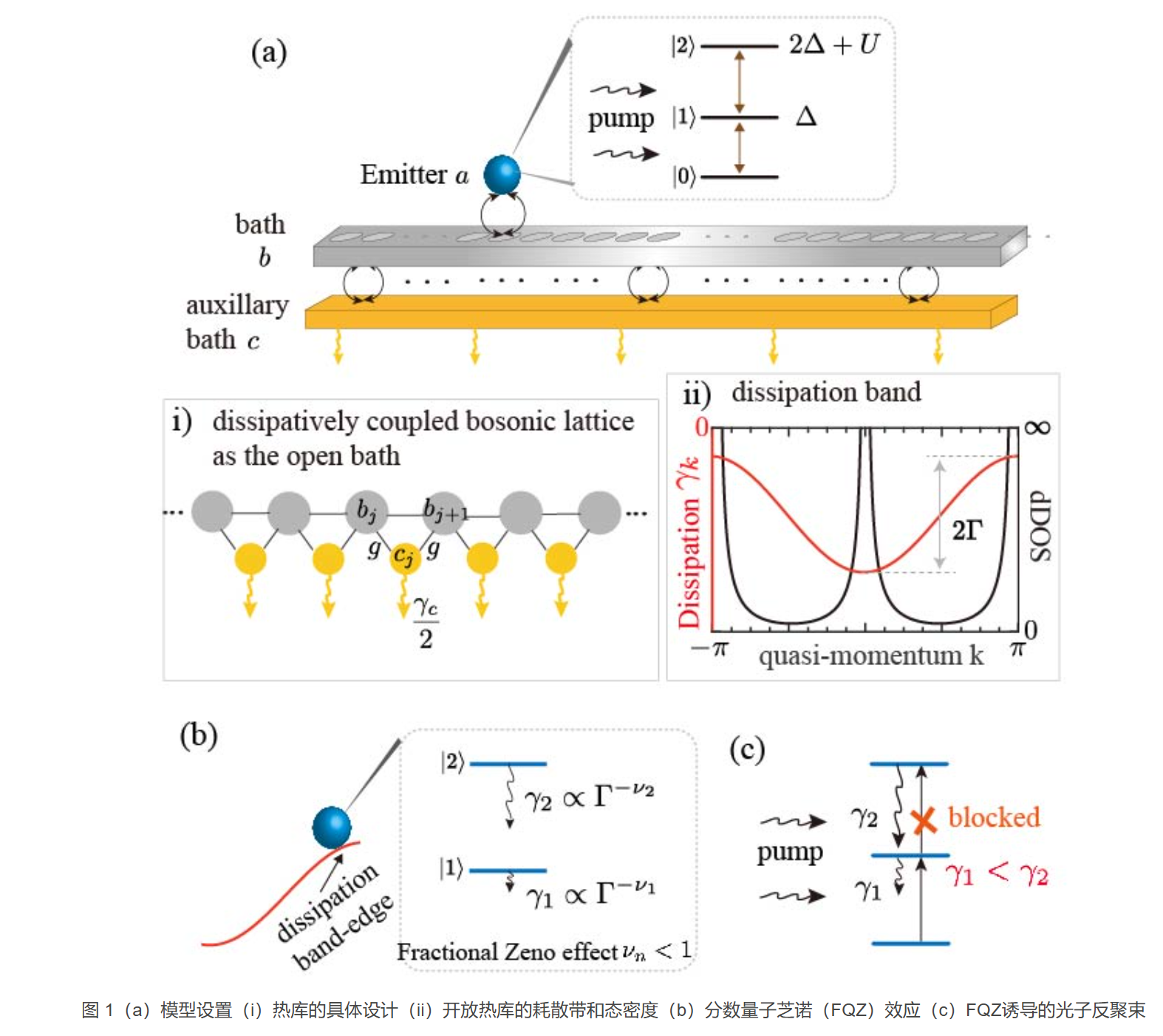
The theoretical research conducted by the team opens new avenues for non-Hermitian quantum optics and paves the way for realizing intriguing quantum non-Hermitian many-body effects and related applications.
This work was supported by funding from the National Key R&D Program of China, the National Natural Science Foundation of China, and other scientific research projects.
Link to the paper: https://journals.aps.org/prx/abstract/10.1103/PhysRevX.13.031009